Strong anti-paper leak bill passed in Rajyasabha also,Modi said- won’t spare mafia playing with future of children
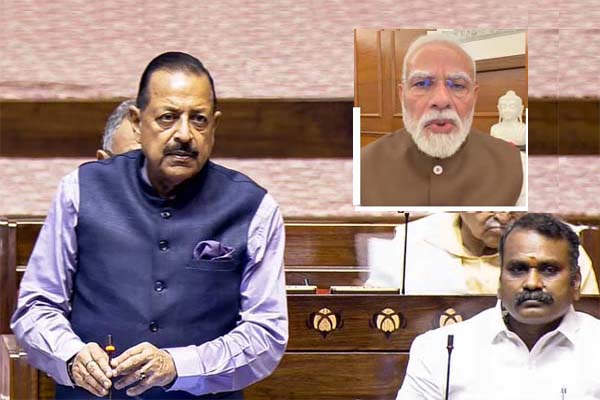
Prime Minister Narendra Modi on Thursday said it had become necessary to bring comprehensive reforms to the education system to tackle the menace of paper leaks and asserted that there would be no mercy for those playing with the future of children. Earlier, Union Minister of State , Dr. Jitendra Singh today moved the Public Examinations (Prevention of Unfair Means) Amendment Bill, 2026, as passed by the Lok Sabha, for consideration in the Rajya Sabha. After this bill is passed by both Houses of Parliament—the Rajya Sabha and the Lok Sabha—it will be sent to the President for approval. Once the President gives assent, it will become law.
In a late evening video message on Instagram shortly after Parliament passed a bill to amend the anti-paper leak law to introduce stricter punishments, Modi said the it was part of the government’s efforts to tackle the menace that has threatened the future of children and posed a challenge for the Centre as well as several states.
This was the third video message posted by Modi on his Instagram handle in the last week.
“The Centre and many states have been facing the paper leak problem for several years,” he said, adding that the menace has threatened the future of children appearing in various examinations.
“Therefore, it had become necessary to bring comprehensive changes to the education system to deal with the problem,” he added.
The prime minister said the government has been continuously working to establish a robust examination system, which also requires extensive use of technology.
“A task force has been constituted, fast-track courts are being set up, and we are seeking suggestions from states to strengthen the examination process and prevent irregularities,” he said.
Referring to the anti-paper leak bill, which was passed by the Lok Sabha on Wednesday and the Rajya Sabha on Thursday, Modi said that as promised, a strong law was now in place to tackle the issue.
Earlier, Union Minister of State (Independent Charge) for Science & Technology; Earth Sciences and Minister of State in the Prime Minister’s Office, Personnel, Public Grievances and Pensions, Atomic Energy and Space, Dr. Jitendra Singh today moved the Public Examinations (Prevention of Unfair Means) Amendment Bill, 2026, as passed by the Lok Sabha, for consideration in the Rajya Sabha.
Initiating the discussion on the Bill, Dr. Jitendra Singh said the Amendment Bill is a natural extension of the Public Examinations (Prevention of Unfair Means) Act, 2024 and that the 2024 Act together with the present Amendment Bill constitute the country’s first comprehensive legislative framework of their kind in independent India to prevent unfair means in public examinations. He said the legislation reflects the Government’s commitment to safeguarding the interests of students and youth while ensuring merit, consistency, transparency and credibility in the public examination system.
The Minister said the Government remains open to constructive suggestions and has brought forward the amendments after taking into account recent experience and feedback, with the objective of making the law more stringent and effective. He said the amendments reaffirm the Government’s policy of zero tolerance towards examination malpractices and paper leaks while ensuring that the genuine efforts of students are protected.
Highlighting the need for the legislation, Dr. Jitendra Singh said incidents of question paper leaks and examination-related malpractices have been reported across different parts of the country over the years, irrespective of the State or the agency conducting the examination, underscoring the need for a robust national legal framework.
The Minister informed the House that the Public Examinations (Prevention of Unfair Means) Bill was introduced in January 2024, enacted in February 2024, while the Act came into force and the Rules were notified in June 2024. He said the Act covers examinations conducted by major recruitment agencies, including the Union Public Service Commission (UPSC), Staff Selection Commission (SSC), Railway Recruitment Boards (RRBs), Institute of Banking Personnel Selection (IBPS) and the National Testing Agency (NTA) for admissions to higher educational institutions.
Dr. Jitendra Singh said the objective of the legislation is to ensure greater consistency, credibility and transparency in public examinations so that sincere and deserving candidates are rewarded for their genuine efforts and their future is not jeopardised by organised examination-related crimes.(updated on 30th July 2026)