Lok Sabha Passes Public Examinations Amendment Bill, 2026
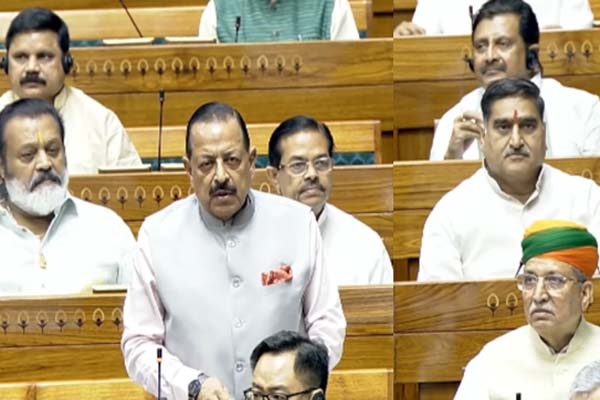
The Lok Sabha today passed the Public Examinations (Prevention of Unfair Means) Amendment Bill, 2026 by a voice vote after an extensive discussion. Replying to the debate, Union Minister of State (Independent Charge) for Science & Technology; Earth Sciences and Minister of State in the Prime Minister’s Office, Personnel, Public Grievances and Pensions, Atomic Energy and Space, Dr. Jitendra Singh said the amendments would further strengthen the legal framework to prevent unfair means in public examinations and safeguard the interests of students and youth.
Dr. Jitendra Singh said the Government remains committed to ensuring the integrity, transparency and credibility of the public examination system. He said the amendments reflect the Government’s openness to incorporate constructive inputs, learn from experience and further strengthen the law in order to effectively tackle organised examination-related crimes.
The Minister noted that the Public Examinations (Prevention of Unfair Means) Act, 2024 was enacted to provide a comprehensive legal framework to curb unfair means in public examinations conducted by major recruitment agencies, including the Union Public Service Commission (UPSC), Staff Selection Commission (SSC), Railway Recruitment Boards (RRBs), Institute of Banking Personnel Selection (IBPS) and the National Testing Agency (NTA) for higher education admissions. He said the Act had already made offences under its ambit cognizable, non-bailable and non-compoundable with stringent penal provisions.
Highlighting the key provisions of the Amendment Bill, Dr. Jitendra Singh said the punishment for persons resorting to unfair means has been enhanced from imprisonment of three to five years to five to ten years, while the maximum fine has been increased from ₹10 lakh to ₹50 lakh. For service providers involved in such offences, the maximum fine has been enhanced from ₹1 crore to ₹5 crore and the period of debarment from conducting public examinations has been increased from four years to eight years. Punishment for directors and senior management of service providers has also been enhanced from three to ten years’ imprisonment to five to ten years, with the maximum fine increased from ₹1 crore to ₹5 crore. The Bill further enhances punishment for organised crime from five to ten years’ imprisonment to seven to ten years and increases the maximum fine from ₹1 crore to ₹10 crore.
The Minister said the Amendment Bill provides for the establishment of Special Fast Track Courts for offences relating to public examinations and envisages completion of investigation within two months and completion of trial within three months from the date of filing of the charge sheet. The Bill also provides for appointment of Special Public Prosecutors and empowers the Government to constitute a Special Task Force for investigation of offences under the Act, thereby ensuring swift and effective action against organised examination-related crimes. He also referred to the Prime Minister’s announcement of a high-level task force comprising eminent experts to make the public examination system “leak-proof” and said substantial progress has been made in implementing the recommendations aimed at strengthening the examination ecosystem.
Referring to the implementation of the 2024 Act, the Minister said that 52 FIRs have already been registered under its provisions, demonstrating the Government’s commitment to strict enforcement and prompt action against examination-related offences. He said the objective of the amendments is to ensure that honest and deserving students are rewarded for their genuine efforts while organised examination-related crimes are dealt with through stringent legal provisions and speedy justice.
Concluding the discussion, Dr. Jitendra Singh said the passage of the Amendment Bill marks another significant step towards reinforcing public confidence in the fairness, transparency and credibility of the country’s public examination system while safeguarding the aspirations of millions of students and job aspirants. (UPDATED ON 29TH JULY 2026)