Science leaders discuss to convert research outcomes to real-world applications
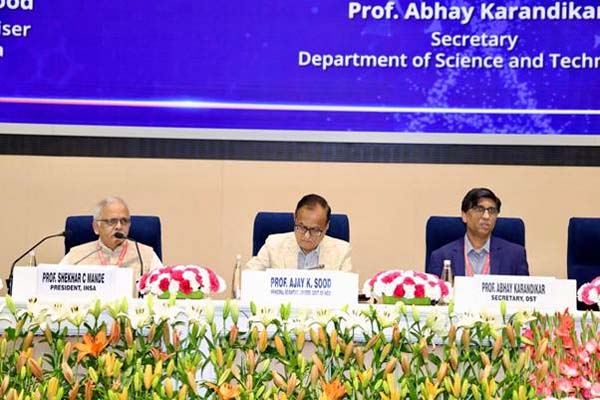
Science–policy convergence is essential to realise the vision of Viksit Bharat, said Principal Scientific Adviser (PSA) to the Government of India, Prof. Ajay K. Sood, while chairing the National Science Day Lectures at the National Science Day Celebration–2026 held at Plenary Hall, Vigyan Bhawan, New Delhi.
The celebration, organised under the focal theme “Women in Science Catalysing Viksit Bharat,” featured three National Science Day Lectures followed by a panel discussion on Science Policy Interface for Catalysing Viksit Bharat.
In his address, Prof. Ajay K. Sood emphasized that India’s scientific advancement must be closely aligned with policy direction and national missions. He underlined that sectors such as aerospace, defence, critical metals, advanced materials and digital communication require coordinated institutional mechanisms and sustained research investment.
Prof. Abhay Karandikar, Secretary, Department of Science and Technology (DST), in his address, emphasized that India’s science policy architecture must support both frontier research and translational innovation.
Prof. Shekhar C. Mande, President, Indian National Science Academy (INSA), during the panel discussion, emphasized the importance of sustained dialogue between scientists and policymakers. He highlighted that evidence-based policymaking must be informed by scientific expertise and rigorous research.
Shashi S. Vempati, Former CEO, Prasar Bharati, delivered a lecture on “Direct to Mobile Broadcasting: India’s Next Digital Leapfrog.” He described Doordarshan’s journey across different information and communication technology phases, leading towards direct-to-mobile broadcasting in collaboration with IIT Kanpur and a startup partner.
Dr. K. Balasubramanian, Director, Non-Ferrous Technology Development Centre (NFTDC), delivered a lecture titled “Roadmap & Solutions for Critical Metals: An Integrated Approach.”
Dr. Shubha V. Iyenger, Former Distinguished Scientist, CSIR–National Aerospace Laboratories (CSIR-NAL), delivered a lecture on “Made in India Technologies for Aerospace and Defence,” highlighting “Drishti,” India’s first indigenous runway visibility measuring system. She was conferred the Padma Shri in 2026 for developing Drishti.(UPDATED ON 28TH FEBRUARY 2026)