Bengal’s Journey Towards Creating a Global Climate Education Model
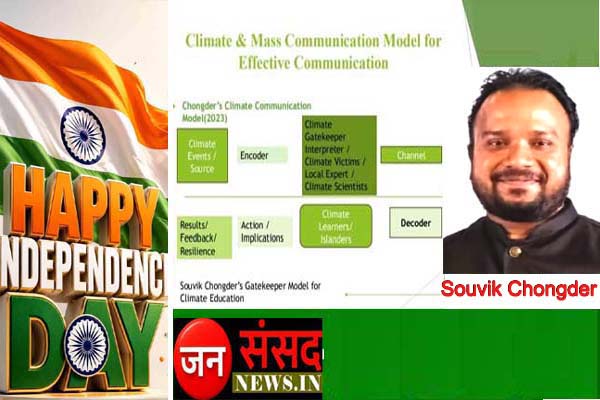
Not only for India’s 1.4 billion people, but for the world’s 8.4 billion people, Bengali climate journalist Souvik Chongder is taking an initiative to develop a new model of climate education.
Beginning his professional journey in Howrah district, Souvik Chongder has been working internationally in the fields of climate journalism and climate communication. In 2023, he began piloting a climate education model with 20 school students in the Sundarbans. Later, in 2024, he analysed various aspects of this model on the global climate conference platform in Baku, Azerbaijan. His work has not been limited to India; through online platforms, Souvik has also worked with school students in Sudan and Zimbabwe in Africa.
Souvik’s climate education model has been developed around two major frameworks. The first is a knowledge- and awareness-based educational approach consisting of six distinct pathways designed to connect students with climate knowledge, understanding of local climate risks, and preparedness for the future. An important element of this framework is the concept of the Climate Gatekeeper, through which students can become messengers of climate awareness within their families, schools and wider communities.
The second framework consists of six analytical and implementation pathways with particular emphasis on establishing a mandatory Climate Lab in schools creating knowledge connections between students and experienced or elderly members of the community, and using Community Radio as a medium for climate communication.
However, one of the most innovative concepts within this model is Climate Gaming.
Mr. Souvik describe .., Climate Gaming does not necessarily mean the use of advanced technology, virtual reality or expensive digital equipment. Instead, the approach focuses on using easily available materials, local knowledge, group-based games, scenario-based exercises and real-life experiences to teach students how to prepare for climate-related disasters before they occur and how to make appropriate decisions during emergencies.
The objective of the model is not merely to provide information about climate change. Rather, it aims to take children and adolescents through a journey from knowledge to decision-making, from decision-making to preparedness, and from preparedness to climate action.
Souvik says that the model has recently reached the relevant climate education space at Oxford University in Europe. He also states that representatives from 21 countries will monitor the model’s progress and potential applications through 2030. He said, the model has also been submitted for presentation within the relevant United Nations climate change framework.
Souvik Chongder says, Climate education is not merely a subject; it is a social system for protecting future generations. If the lessons that began in a climate-vulnerable region like the Sundarbans can reach children living on islands, coastlines, deserts, mountains and flood-prone regions, climate education can become a global people’s movement.
He further says that discussions are scheduled this week with representatives from Istanbul, Australia and Canada. Yesterday he had done high level meeting with Istanbul Climate Chsmpions, The objective is to adapt the model according to the needs and realities of different countries and regions and take it to a larger number of schools around the world.
An initiative that began in Bengal’s Sundarbans could now, if it reaches children across the world’s islands and coastal communities, become a new example of how local experience can generate global solutions in climate education(UPDATED ON 14TH AUGUST 2026)