What does “second-class passenger” mean? SC
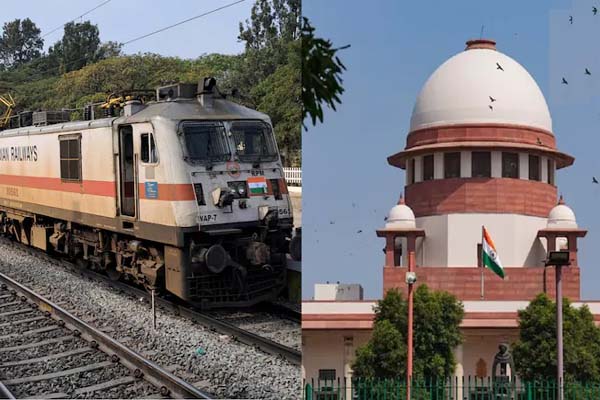
The Supreme Court has delivered an important judgment regarding reforms in Indian Railways and passenger safety. A bench of Justice Sanjay Karol and Justice N. Kotiswar Singh strongly objected to the use of the term “second-class passenger” in railway documents. The apex court clarified that, given India’s historical background of class divisions, addressing a person in this manner is contrary to the spirit of the Constitution. The court directed that a passenger’s classification should not be determined by the amount they spend, but by the coach in which they are traveling. Therefore, in the future, the class should be referred to only in the context of the coach or compartment, not the passenger.
At the same time, while granting relief to the wife of a passenger who died after falling from a train, the Supreme Court overturned the decisions of the Railway Claims Tribunal and the Madhya Pradesh High Court. The court said that merely because no travel ticket was found on the deceased, he could not be considered a ticketless passenger. The Supreme Court noted that the deceased’s wife had clearly stated in her affidavit that her husband had a valid railway ticket, but his bag, which contained the ticket, was lost during the accident. The court observed that there was no dispute that the deceased was traveling on the train and that his death occurred due to an untoward railway incident. Advocate-on-Record Shweta Priyadarshini appeared through legal aid for the petitioner-wife.
In the judgment authored by Justice Karol, the Supreme Court commented on railway safety measures and passenger convenience, stating: “Many provisions of the Railway Manual require more staff for effective implementation.” The bench said that the number of employees working at railway stations and on trains must be significantly increased. In this era of modernization, providing employment to young people in the railways would not only give them stable livelihoods but would also help save passengers’ lives. The court further said that, considering India’s history of class divisions, calling someone a “second-class passenger” appears to be against the spirit of the Constitution. Therefore, it would be preferable to refer to the class in relation to the coach or compartment rather than the passenger.
The court also stated that, according to previous judicial decisions, the failure to recover a ticket from a deceased passenger does not by itself deprive the person of the status of a lawful passenger. For the initial establishment of the claim, the wife’s affidavit was sufficient. Referring to the Railway Manual, the Supreme Court said that if the prescribed ticket-checking procedure had been followed, there would have been a record showing that the passenger’s ticket had been checked, and the dispute would not have arisen. The Supreme Court directed that the wife be paid compensation of ₹800,000, along with interest. (Courtesy: NDTV)(UPDATED ON 17TH JULY 2026)