Fourth Edition of IICA’s National Conference on Responsible Business Conduct
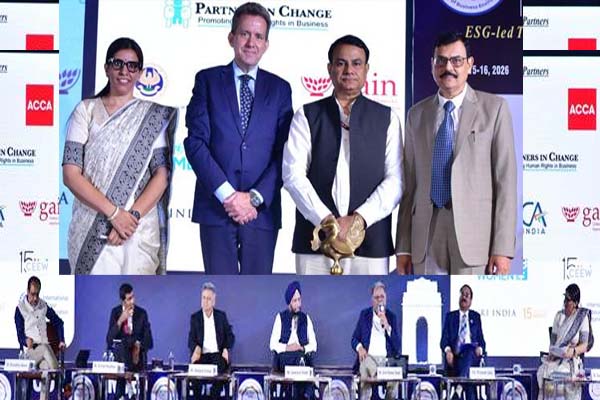
The fourth edition of the National Conference on Responsible Business Conduct (NCRBC) 2026 was inaugurated in New Delhi. The two-day conference themed “ESG-led Transformation for Viksit Bharat” has been organised by the School of Business Environment (SBE) of the Indian Institute of Corporate Affairs (IICA), an autonomous institution under the Ministry of Corporate Affairs, Government of India.
Delivering the Special Address, Nitin Gupta, Chairperson, National Financial Reporting Authority (NFRA), emphasised that Responsible Business Conduct is integral to the vision of Viksit Bharat and to fostering competitive enterprises, trusted markets, inclusive growth and environmental sustainability.
Delivering the Welcome Address, Gyaneshwar Kumar Singh, Director General and CEO, Indian Institute of Corporate Affairs (IICA), stated that India’s aspiration of becoming a USD 30 trillion economy by 2047 requires Environmental, Social and Governance (ESG) principles to move beyond regulatory compliance and become an integral part of the country’s economic development model.
In a special address Jesper Moller, Deputy Representative (Programmes), UNICEF India, said child rights must be integrated into core business strategy rather than treated as a philanthropic concern, noting that India is home to over 400 million children who represent its future workforce and consumers.
Speaking virtually, Ms. Helen Brand, Chief Executive, ACCA (Association of Chartered Certified Accountants), reaffirmed ACCA’s partnership with IICA on sustainable business practices, describing India’s economy as a “rocket ship bound to the moon” given its rapid growth and rising global influence.
Professor Garima Dadhich, Head, School of Business Environment, Indian Institute of Corporate Affairs, described responsible business conduct as essential to Viksit Bharat and called for sustainability to be viewed as a foundation for growth rather than a compliance exercise.
Amarjeet Singh, Whole-Time Member, Securities and Exchange Board of India (SEBI), cautioned against rushing to converge with global standards, saying India should chart its own glide path suited to its stage of development rather than align hastily with international frameworks.
Shri Arun Kumar Singh, Chairman, Oil and Natural Gas Corporation (ONGC), said over-promising and under-delivering is “far better” than under-promising, and called on regulators to reward companies for ambition and intent rather than penalise them for falling short. Intent and trust play the key role in governance.
Dr. Arunabha Ghosh, Chief Executive Officer, CEEW (Council on Energy, Environment and Water), said ESG is too often treated as a “headache” rather than an opportunity, pointing to an estimated USD 4 trillion investment opportunity in India’s green economy.
Shailesh Pathak, Senior Advisor, National Stock Exchange (NSE), said capital “goes to where it sees opportunity, but stays where it has trust,” describing the Social Stock Exchange as a transparent bridge between capital and social enterprises.
George Varghese, Managing Director, Kirloskar Industries Limited (KIL), recounted how tighter emission norms, initially seen as a cost burden, ultimately opened up international markets for his company’s products.
CA Pramod Jain, Chairman, Sustainability Reporting Standards Board (SRSB), Institute of Chartered Accountants of India (ICAI), said India has become one of the first countries to make ESG assurance mandatory rather than voluntary, lending board disclosures the same credibility as financial statements. The panel was duly moderated by Prof. Garima Dadhich, Head School of Business Environment, IICA.(UPDATED ON 17TH JULY 2026)