Bharat Tex 2026 Day 3–, Future-Ready Skills and Global Trade
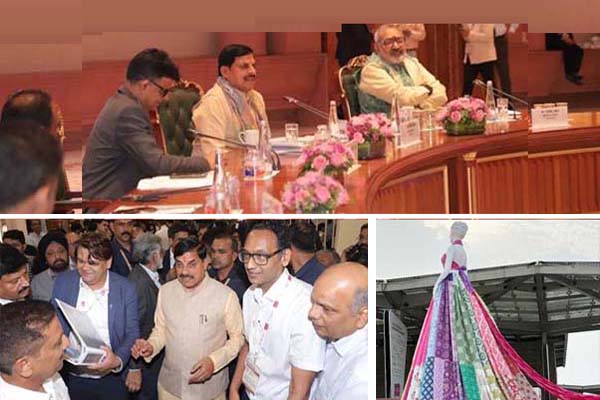
The third day of Bharat Tex 2026 brought together policymakers, State Government representatives, industry leaders, investors, international organisations, brands, academic institutions and sustainability experts for focused discussions on circularity, responsible sourcing, textile financing, future-ready skills, global trade and technology-led growth.
A series of panel discussions, roundtables, workshops, masterclasses and industry interactions highlighted practical pathways for building a competitive, inclusive and environmentally responsible textile sector.
A key highlight of the day was the participation of Dr. Mohan Yadav, Chief Minister of Madhya Pradesh, who visited the Madhya Pradesh State Pavilion and interacted with representatives showcasing the State’s textile heritage, manufacturing capabilities and investment potential.
Dr. Mohan Yadav subsequently participated in the Madhya Pradesh State Session, organised by the Government of Madhya Pradesh. The session highlighted the State’s strengths across the textile value chain and its potential to attract investment, expand manufacturing, generate employment and support industry-led growth. A media interaction was also held following the session. Dr. Mohan Yadav highlighted the State’s textile potential and investment opportunities.
Sustainability and circularity remained central to the programme. The United Nations Development Programme session on the India Sustainable Textile Mark featured Ms. Nalini Shekar, Co-Founder, Hasiru Dala.. The session “Wheat Straw to Wardrobes” featured Dr. Ravinder Tuteja, Material Program Lead, H&M, and explored the development of next-generation textile fibres from agricultural residue.
The roundtable “Circular Textile: From Dialogue to Deployment”, featuring i Archish Kansal, Director, Respun, focused on translating circularity commitments into practical and scalable solutions. T
he discussion “Fair Commodity Pricing: An Industry Model for an Equitable and Resilient Organic Cotton Value Chain” featured Jagjeet Singh Kandal, Country Director, India, IDH India Hub Private Limited, and Ms. Danique Lodewijks, Sustainable Raw Materials Manager, Bestseller.
The session underlined the need for transparent pricing, protection of farmer interests and long-term partnerships across the organic cotton value chain. The panel “Financing a Globally Competitive, Sustainable, Inclusive Supply Chain”, featuring Aakash Shah, Partner, Peak Sustainability Ventures, examined financing mechanisms for resilient and responsible textile supply chains.
The Better Cotton Initiative roundtable “Dialogue for Sustainable Sourcing Solutions to Drive Textile Trade” brought together Ms. Eva Benavidez Clayton, Senior Director of Demand and Engagement, Better Cotton Initiative; Paul Wright, Group Environmental, Social and Governance Executive Director, PDS Limited; Anant Ahuja, Director of Environmental, Social and Governance and Sustainability, Shahi Exports Private Limited; Dilip Kumar, Traceability Manager, Marks and Spencer; and Srinivasan Krishnamurthy, Material Development Lead, IKEA Group.
The roundtable “Weaving Capital In: Investor Perspectives on India’s Textile Sustainability Journey” featured Ms. Ranjna Khanna, Senior Director, Programs, Impact Investors Council; Jai Kumar Gaurav, Senior Advisor for Climate Change and Circular Economy, Deutsche Gesellschaft für Internationale Zusammenarbeit; and Dr. Priya Nagaraj, Head, Green Economy and Innovation, Council on Energy, Environment and Water.
The e-commerce masterclass “From Bharat to the World”, featuring Pulkit Nanda, Head of New Seller Recruitment, Global Sales, Amazon Global Selling, highlighted how export preparedness and digital marketplaces can help Indian textile enterprises reach global customers.
A fireside conversation with Dr. M. Beena, IAS, Development Commissioner for Handlooms, Ministry of Textiles, Government of India, and Ms. Priyambada Jayakumar, Author and Historian, reflected on India’s handloom heritage, the contribution of weavers and artisans.
The day concluded with the “Sustainability Conclave: Learnings and Takeaways — Closing Plenary Session,” featuring Ms. Aarti Mohan, Co-Founder and Partner, Sattva Media and Consulting Private Limited.
A panel discussion “Why Indian Fabric Players Struggle to Integrate into Garmenting and What It Will Take to Succeed” included Shreyaskar Chaudhary, Managing Director, Pratibha Syntex Limited, and Kartikayan Ravichandran, Associate Partner, Vector Consulting Group.
The masterclass on “Integrating Sustainable Chemical Management Frameworks into Policy”, led by Saket Damodar Kulkarni, Senior Regional Manager for South Asia, ZDHC Foundation, discussed responsible chemical management, stronger environmental, social and governance compliance and internationally aligned production practices to support India-European Union textile trade.(UPDATED ON 16TH JULY 2026)