Narendra Modi interacts with students from Coimbatore, Raipur, Devmogra and Guwahati
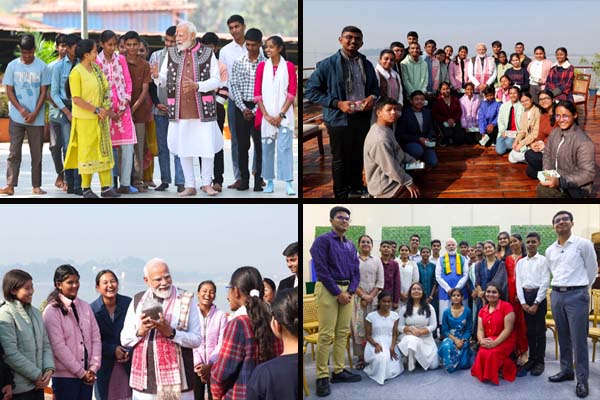
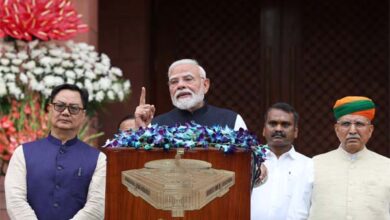
The Prime Minister, Shri Narendra Modi interacted with students today in continuation of 9th edition of Pariksha Pe Charcha (PPC) 2026. The Prime Minister had an informal interaction with Exam Warriors from Coimbatore, Raipur, Devmogra and Guwahati during the second episode of PPC 2026. Welcoming students to the special edition of ‘Pariksha Pe Charcha’, Shri Modi noted that this time the programme was held across different parts of the country. Starting off the Coimbatore edition, PM remarked that the energy and curiosity of Tamil Nadu’s students had deeply impressed him. Greeting them with “Vanakkam,” he engaged in light conversation. Students expressed their excitement, saying they couldn’t believe their eyes when they saw him, expecting a dramatic entry but finding him simple, humble, and down to earth. One student shared that his arrival gave them goosebumps.
Startups & PM’s mantra to study
The Prime Minister highlighted that for many years he has been interacting with 10th and 12th grade students through ‘Pariksha Pe Charcha’, emphasizing that it is a learning programme for him, not a teaching one, and invited students to share their thoughts. Responding to a student’s query on startups, he remarked that the first focus should be on what one wants to do, whether innovation in technology or practical solutions like drones or electricity systems. He advised forming small teams with friends skilled in technology or finance. He highlighted that there is no age requirement for starting a venture, and even small startups can be impactful. He remarked that if there is genuine interest, it is a very good thing. He suggested visiting existing startups, preparing a project report, and presenting it honestly as a school project, which would encourage guidance and support. He concluded that gradually, valuable knowledge will be gained on how to proceed..
Addressing another student’s concern about balancing studies and passion, Shri Modi highlighted that both are useful and can complement each other. He illustrated with an example of combining art with science experiments, saying creativity can help in learning and reduce fatigue, recommending dedicating daily or weekly time to personal interests while ensuring education remains a priority.
Addressing another question on Artificial Intelligence, the Prime Minister remarked that every era has faced concerns with new technologies, whether computers or mobile phones, but fear is unnecessary. He emphasized that technology must not become the master of human life, cautioning against becoming enslaved to devices. He stated firmly, “I will not become a slave,” and advised that AI should be used for guidance and value addition, not as a substitute for learning. He noted that the nature of jobs will always evolve, just as transport shifted from bullock carts to airplanes, but life continues. He highlighted that understanding technology, expanding one’s own capabilities, and integrating its strengths into work ensures progress without fear.
When asked what qualities he expects from the future generation as leaders, the Prime Minister remarked that the first quality is to be fearless. He advised that leadership begins when one decides to act without waiting for others, giving the example of picking up litter which inspires others to follow. He clarified that leadership is not about elections or speeches but about the ability to explain and convince others, stressing that true leaders first understand people before guiding them. Students expressed admiration, describing the experience as a dream, feeling lucky and honored to meet the Prime Minister.
Responding to a question about his inspiration for working in tribal areas, Shri Modi recalled the historic Palchetaria incident where the tribal community fought a major freedom struggle, and also the severe famine during which he stayed in the region and felt the need to focus on education. He remarked that when he became Chief Minister, he prioritized education, noting that there was once not a single science school from Umargam to Ambaji, but now there are universities, science schools, engineering institutes, and ITIs, bringing significant change and benefits. He highlighted the creation of the PM Janman Yojana to support tribal communities who remain further behind, explaining that separate schemes and budgets were required. He emphasized that education accelerates development and also pointed to infrastructure projects like the Umargam–Ambaji highway, remarking that connectivity is vital for progress and has been a key area of focus.
Prime Minister Modi, responding to a student’s question on the role of teachers in his life, remarked that they played a very significant role. He recalled how his teacher encouraged him daily to visit the library, read the editorial line in The Times of India, write it down, and discuss it the next day, which instilled discipline and curiosity. He shared memories of Parmar Sir from his primary school days, who was insistent on physical fitness, teaching him yoga and mallakhamb, which helped him understand the importance of health even though he did not become a professional player. He emphasized that in the life of every great personality, two influences are always acknowledged—their mother and their teacher..(updated on 9th feb 2026)