Ministry of Culture to Present Tableau 2026 on ‘150 Years of Vande Mataram
’
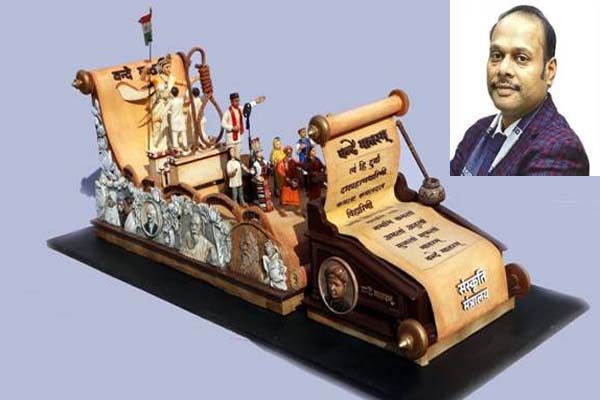
The Ministry of Culture will present a tableau on the theme ‘150 Years of Vande Mataram’ at the Republic Day Parade 2026, foregrounding the national song as a living expression of India’s civilisational memory, collective consciousness, and cultural continuity.
Informing on the theme, Vivek Agarwal, Secretary, Ministry of Culture, remarked that India’s Republic Day tableaux are far more than ceremonial displays; they function as moving archives of the nation’s civilisational memory. Year after year, they translate ideas, values, and historical experience into a shared visual language, reaffirming that culture is not an ornament of the Republic, but its sustaining spirit. Within this continuum, Vande Mataram occupies a singular and enduring place.
He noted that once spoken on the lips of revolutionaries and sung in prisons, meetings, and processions, Vande Mataram is far more than a song. Sri Aurobindo perceived in it a spiritual potency capable of awakening collective consciousness—a vision that history has since affirmed. Composed in 1875 by Bankimchandra Chattopadhyay, the song envisioned the nation as Mother—sujalam, suphalam—abundant in nature, nurture, and inner strength. During the colonial period, it restored dignity and self-belief, transforming devotion into courage and poetry into resolve, and uniting Indians across regions, languages, and faiths in a shared aspiration for freedom.
The Ministry of Culture’s Republic Day tableau for 2026 gives this long and layered journey a powerful visual form. The moving tractor carries the original manuscript of Vande Mataram, followed by folk artists drawn from the four directions of India, embodying the country’s cultural plurality. At the centre of the tableau stands the present generation, represented by Gen – G, who renders Vande Mataram inspired by the historic rendition of Vishnupant Pagnis. His recording of the song in Raga Sarang, achieved by altering the sequence of verses to circumvent colonial censorship, became a significant example of artistic resistance during the freedom movement.(updated on21st january 2026)